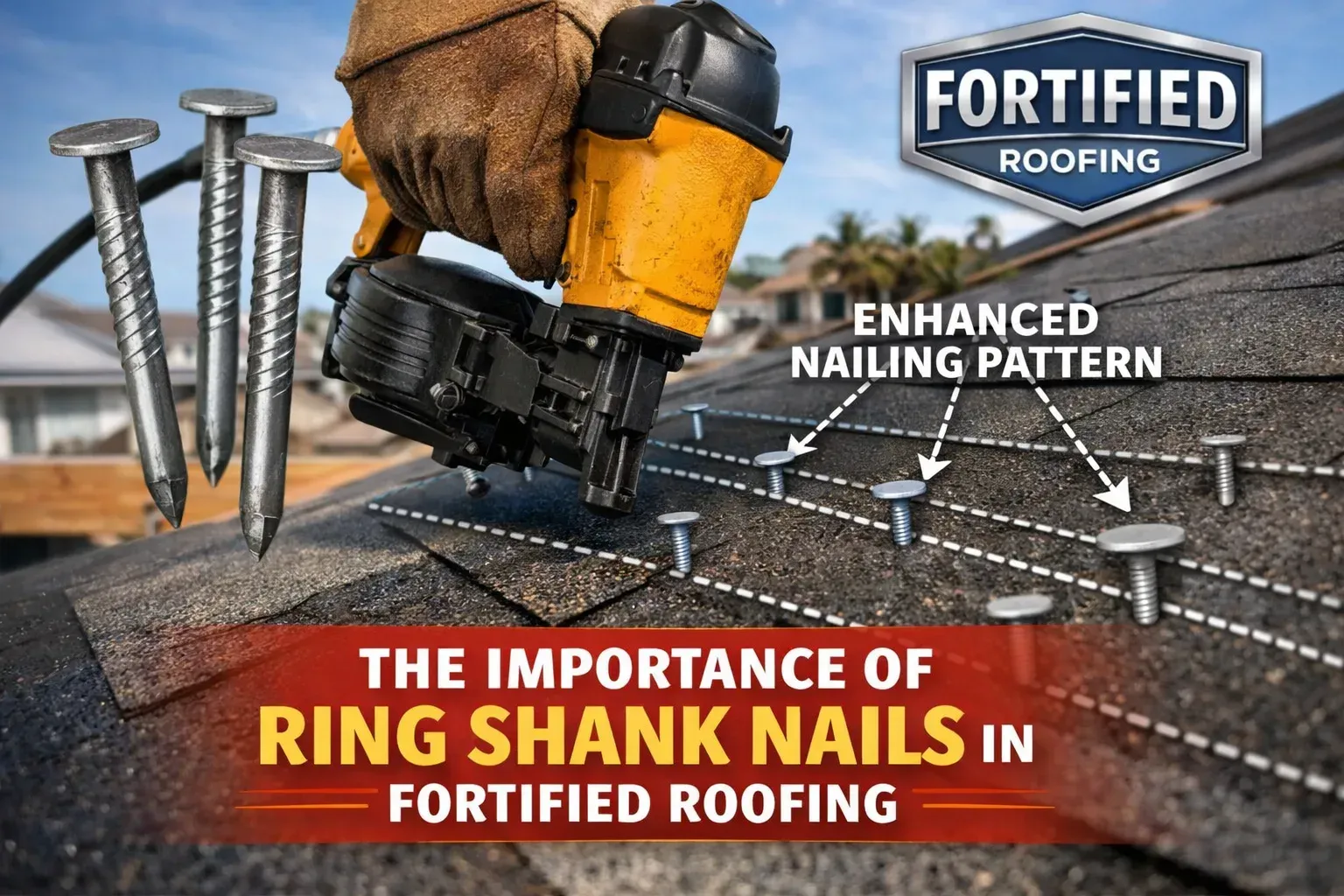
The Importance of Ring-Shank Nails in an Enhanced Pattern for Fortified Roofing
In Mobile, Alabama, wind uplift can test connections hidden beneath a finished roof. Ring-shank nails in an enhanced roof-deck fastening pattern help secure plywood or OSB sheathing to the rafters or trusses beneath it. Learn why the fastener, spacing, and installation requirements matter for FORTIFIED roofing—and why those details must work with the rest of the roof system.
Why Fastener Choice Matters More Than Most Homeowners Realize
Homeowners often think about a new roof in terms of shingles, color, underlayment, and appearance. Yet one of the most important connections is hidden below the finished roof: the fasteners attaching plywood or OSB roof sheathing to the rafters or trusses beneath it. When strong winds create uplift pressure, that deck-to-framing connection helps determine whether the sheathing stays in place.
Roof-deck nails are not the same as shingle nails. The ring-shank fasteners discussed here secure structural roof sheathing to framing; the nails that attach asphalt shingles to the deck perform a separate function. Both connections matter, but they must be evaluated independently. Enhanced roof-deck attachment is one component of a complete FORTIFIED roof installation in Mobile, Alabama.
Article Index
Core Concepts
What Are Ring-Shank Nails?
Ring-shank nails have raised rings along part of the shaft rather than a completely smooth shank. When driven into wood framing, those rings help resist withdrawal. That makes appropriately specified roof-sheathing ring-shank nails useful where high winds may try to lift decking away from rafters or trusses.
Not every ring-shank nail is interchangeable. Nail length, shank diameter, head dimensions, penetration into framing, and the relevant product specification all matter. Simpson Strong-Tie explains the engineering behind roof-sheathing ring-shank nails, including withdrawal resistance and the importance of appropriate fastener dimensions.
These nails attach the roof deck to its supporting structure; they do not replace the separate fasteners and installation requirements for shingles, metal panels, roof-edge components, or flashing.
↑ Back to Top1. Increased Holding Power Is the Foundation of the Upgrade
The key advantage of a properly specified ring-shank nail is its resistance to being withdrawn from wood. During strong winds, uplift can repeatedly load the connection between roof sheathing and framing. Better withdrawal resistance can help keep the decking attached instead of allowing a weak fastening point to loosen or pull free.
Withdrawal resistance is only one part of performance. Nail-head pull-through, sheathing thickness and condition, framing condition, and correct installation also matter. When an existing roof is being replaced, the exposed deck can be inspected and its attachment upgraded where needed. That is one reason FORTIFIED roof replacement in Mobile can offer an opportunity to address details a homeowner cannot see beneath the old roof covering.
2. Enhanced Wind Resistance Is Critical on the Gulf Coast
During severe thunderstorms, tropical storms, and hurricanes, wind pressure does more than push across the roof surface. It can create uplift that works against roof coverings, edges, and the sheathing beneath them. Roof edges and corners can experience particularly demanding wind forces, making sound construction details essential.
Ring-shank nails installed in the appropriate roof-deck attachment pattern help resist those forces at the sheathing-to-framing connection. They cannot eliminate storm damage, and they are not a substitute for properly secured roof coverings or a sealed roof deck. They are one part of the layered approach described in our guide to hurricane preparedness and roof protection.
Standard Concern
Wind uplift can exploit weak deck attachments, potentially exposing the home if sheathing separates from the framing.
FORTIFIED Approach
Prescribed deck attachment works alongside a sealed roof deck, compliant coverings, and other verified installation details.
3. Improved Durability and Long-Term Roofing Performance
The rings on a ring-shank nail improve mechanical grip; they do not automatically make the nail corrosion-resistant. Resistance to rust depends on the fastener material, coating, exposure conditions, and the applicable installation specification. Along the Alabama Gulf Coast, selecting appropriate corrosion protection is particularly important where salt-laden air may affect building components.
Long-term performance also depends on sound decking, adequate framing, correct nail installation, and keeping other roof components maintained. A roof that was installed well still deserves periodic attention after storms and as it ages. Our article on regular roof inspections and maintenance in Mobile explains how homeowners can identify issues before they become larger repairs.
The goal is not a promise that a roof will never fail; it is a more resilient assembly with fewer avoidable weak points.
↑ Back to TopWhy the Enhanced Nailing Pattern Is Just as Important as the Nail Itself
A strong individual fastener only protects the connection where it is installed. An enhanced roof-deck attachment pattern specifies how sheathing is fastened to the framing across the roof. Depending on the applicable FORTIFIED detail, the contractor must consider nail type and size, spacing, penetration, framing locations, and the existing condition of the deck.
For re-roofing projects, an evaluator and contractor may determine whether existing attachments meet the applicable requirements or whether supplemental fastening or deck replacement is needed. That decision should follow the current standard and project conditions, rather than a blanket instruction to add nails at a guessed spacing.
1. An Enhanced Pattern Helps Distribute Stress More Evenly
Wind uplift is not necessarily uniform across a roof. Corners, perimeter areas, and other locations may be exposed to higher loads. A properly designed fastening pattern creates multiple points of attachment, helping the roof sheathing transfer uplift forces into the framing rather than relying on too few or poorly installed nails.
That benefit depends on the complete connection: the fastener, the sheathing, the supporting member, and sound installation. Nails driven into damaged wood, placed incorrectly, or installed with inadequate penetration may not provide the intended strength.
For Mobile homeowners, the important question is not simply whether a contractor uses ring-shank nails, but whether the roof deck is attached according to the requirements for that specific project.
↑ Back to Top2. Better Attachment Supports Better Defense Against Water Intrusion
When roof coverings or sheathing detach during a storm, wind-driven rain can reach insulation, ceilings, walls, and other interior materials. Keeping the roof deck connected to its framing helps protect the building enclosure, but deck attachment by itself does not waterproof the roof.
The FORTIFIED approach also addresses a sealed roof deck and other installation details intended to limit water entry if the roof covering is damaged. Flashing and roof penetrations remain important potential leak points. Our guide to how inadequate roof flashing can cause hidden moisture damage explains why even a well-fastened roof needs properly detailed transitions.
Secure Deck Attachment
Helps reduce the chance that roof sheathing separates from its framing during strong uplift.
Layered Water Protection
A sealed roof deck, sound flashing, and properly installed roof coverings address other pathways for rain.
3. Enhanced Nailing Supports Compliance with Higher Standards
Building codes and voluntary resilient-construction programs do not always impose identical requirements. FORTIFIED roof-deck attachment is a defined component of the FORTIFIED Home program, not merely a marketing term for using extra nails. The correct fastening detail depends on the applicable standard, whether the work is new construction or re-roofing, and the condition of the existing roof structure.
Homeowners and contractors can review the official 2025 FORTIFIED Home Standard and technical documents for current roof-deck attachment, re-roofing, corrosion-protection, and documentation guidance. The 2025 standard applies to projects permitted on or after November 1, 2025, and to roofs installed from that date where permits are not required. Applicable technical bulletins should also be checked.
Enhanced nailing alone does not earn an official FORTIFIED designation. Qualifying roofs must meet the program's relevant roof-system requirements and be independently evaluated with the required evidence during installation. Ask your roofing contractor how that documentation and evaluation will be coordinated before the roof deck is covered.
↑ Back to TopWhy This Matters So Much for Homes in Mobile, Alabama
Homes in Mobile and Baldwin County face a combination of wind, heavy rainfall, high humidity, and—in some coastal locations—salt exposure. The roof assembly must resist those conditions as a complete system. Roof-deck attachment is one of the construction details that can make a meaningful difference during high-wind events.
Homeowners considering a qualifying FORTIFIED roof may also want to ask their insurer about possible premium credits and the documentation needed to receive them. Benefits vary by policy and insurer; upgraded fasteners by themselves do not establish discount eligibility. See our article on how your roof can lower your insurance premiums for a broader explanation.
When evaluating a roofing proposal, ask how the contractor will inspect the deck, confirm the fastening requirements, address corrosion exposure, and coordinate any necessary independent FORTIFIED evaluation.
↑ Back to TopWhy Choose Pro Roofing Solutions for Your FORTIFIED Roofing Needs
At Pro Roofing Solutions, we understand that FORTIFIED roofing means more than installing a new layer of shingles. It involves carefully coordinated roof-deck attachment, water-protection details, appropriate roof coverings, and proper documentation. Those details matter to homeowners throughout Mobile and Baldwin County.
Our focus is on helping homeowners understand what the installation requires and why each component contributes to wind and water resistance. You can also meet the family behind Pro Roofing Solutions and learn more about our local roofing business.
- Local roofing experience built around Gulf Coast weather demands
- Attention to roof-deck fastening and other critical installation details
- Guidance on FORTIFIED requirements and independent evaluation
- Professional service focused on protecting your home long-term
Build a Stronger Roof for Mobile Weather
A properly designed FORTIFIED roof system may use enhanced roof-deck attachment with specified ring-shank nails to help resist wind uplift. The strongest protection comes from coordinating that attachment with the sealed roof deck, roof coverings, and other verified details. In a place like Mobile, AL, those details can make a real difference when the weather turns severe.
If you want to learn more about fortified roofing options for your home, Pro Roofing Solutions is here to help you build with confidence.
Call 251-376-5810Final Thoughts
Ring-shank nails may seem like a small detail, but the connection between roof sheathing and framing is essential during high winds. When the specified fasteners are installed in the correct pattern and combined with a properly sealed and covered roof deck, the result can be a more resilient roofing system. For Mobile homeowners, the key is a complete installation that follows the applicable FORTIFIED requirements—not simply adding more nails.
Looking for fortified roofing in Mobile, AL? Pro Roofing Solutions is available at 251-376-5810.
↑ Back to Top